

White Supremacy Doesn't Exist
It's Functionally Extinct

In this essay I make a very direct claim: anti-black racism barely exists in our powerful institutions these days, and white supremacy is completely absent… even on the most extreme fringes of the right. NO ONE is advocating structures for the racialized oppression of black people. Rather, people are debating the fitness of black people and advocating for merit-based criteria, and these conversations are being labelled “white supremacist.”
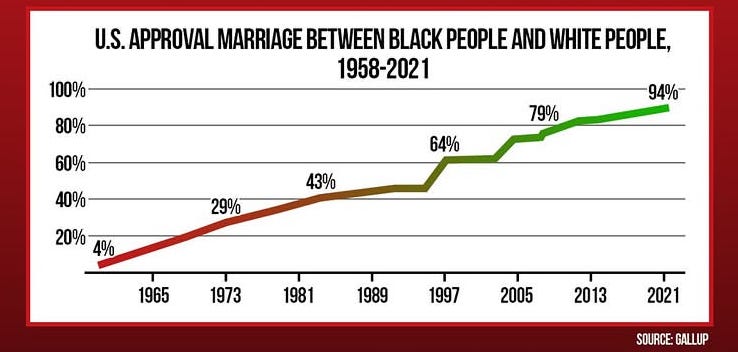
White supremacy might hold the world historical record for the political construct with the greatest distance between perceived influence and actual power.
White supremacy is blamed for many things. It’s blamed for the social and sexual preference of many ethnicities (Indian, Korean, Chinese, etc.) for lighter-skinned people. This is not “rooted in” white supremacy. It’s rooted in generations of people working outside and getting sun, and lack of dark skin (i.e. the privilege to stay inside, well-fed, in relatively luxurious surroundings) therefore gaining an association with fairer skin. It’s blamed for the comparative underperformance of black students in the United States… although no one has really described a mechanism for how this could be the case, and the factors which are under the full control of the students in question and their families (attentiveness, work ethic, home literacy and academic support) seem much more decisive in outcomes. It’s blamed for colonialism and prison demographics and fashion magazine covers. It’s blamed for the disproportionate incidence of pregnancy complications among black women compared to nonblack women in the United States. Again, there’s no plausible mechanism for how millions of decidedly non-racist medical providers could be generating these outcomes (and it turns out that the outcomes seem to have more to do with income and lifestyle and obesity and medical compliance patterns than they do with disparities in the medical system).
I don’t think I’ve ever heard anyone push back against these floridly ridiculous narratives. When a guest on a show mentions ‘racism’ or ‘white supremacy’ as a primary cause for some imbalance or some social problem, the response of the hosts is nearly always to nod sagely, as if this reality is undeniable and its referencing profound. In actuality, white supremacy - as a political force - was completely spent decades ago. Even in the spaces which are decidedly racist (where one will often find more forthright and complex discussions than the ones occurring in graduate-level social science survey classes) white supremacy rarely makes an appearance.
Before I continue, I should define my terms. I have tried to stay consistent in my use of these terms throughout my writing. I feel that this is important, as so much of the confusion and division in contemporary political discourse originates in miscommunications - either intentional or unintentional. The pattern I have observed many times is that activists will intentionally redefine or conflate terms, and then these corrupted meanings are taken up by well-meaning simpletons, who aren’t necessarily speaking in bad faith but who are nevertheless perpetuating lexical inaccuracies. In many cases, these corrupted forms find their way into media discourse and are uncritically taken up by elite institutions.
I’ll give you one area, which has probably generated more of these corrupted coinages than any other in a shorter period of time: gender ideology / trans activism. This is unsurprising, as it was the tip of the spear in terms of progressive political energy for much of the past decade. If you want to radically unmake and remake society, there’s no better or surer foundation to attack than sex roles (and thereby romance and the family). ‘Transexual’ became transgender. Neither is precisely true in a literal sense, but transexual gets to the heart of a trans person’s experience more neatly, I think. The person feels that their sex is wrong and wants to cross the sex boundary. If gender is simply a subjective state of mind or a social performance (in the Judith Butler phrasing) then, in the former case, no one could ever be the wrong gender. In the latter, anything that transgressed society’s expectations for behavior or interests or attributes would be ‘transgender.’ In neither case does the word describe someone whose subjective identity doesn’t accord with their biological sex. Again, ‘transexual’ seems to be the obvious choice for this condition. The problems with ‘gender-affirming care’ (a misnomer that quickly swept through every news room and medical school and professional organization in the West, clear evidence of the awesome power of leftist activism among the professional managerial class) are more obvious. Once we get to ‘assigned female (or male) at birth’ (‘afab’, or ‘amab’) we have wandered into a kind of surreal fantasyland, where the priorities and ideological constructs of activists have taken full control and the plain and obvious reality (that 99% of humans are born with fairly obvious sex characteristics and so no assignment is necessary, and that the outliers and hermaphroditic edge cases are simply imperfect expressions of the same binary system) has been dispensed with. And barely anyone said a word.
By the way, hermaphrodite is now only applicable in biology, I think. In humans we have a new (incorrect) term: intersex. Intersex people are not ‘between sexes.’ Nearly all of them produce either large or small gametes, despite their ambiguous genitalia or secondary sex characteristics, and so they are very definitely one sex or the other. They are decidely intrasex, but they’re hermaphroditic. We could spend time talking about the aggressive attempts to derange biology and medicine, or to count common hormonal disorders as ‘intersex’ in order to boost that category’s numbers and erode the sex binary, but this has all been done to death already. Even if few scientists or providers or academics will acknowledge it. Colin Wright has devoted many excellent essays to the subject, and I have linked a few below.

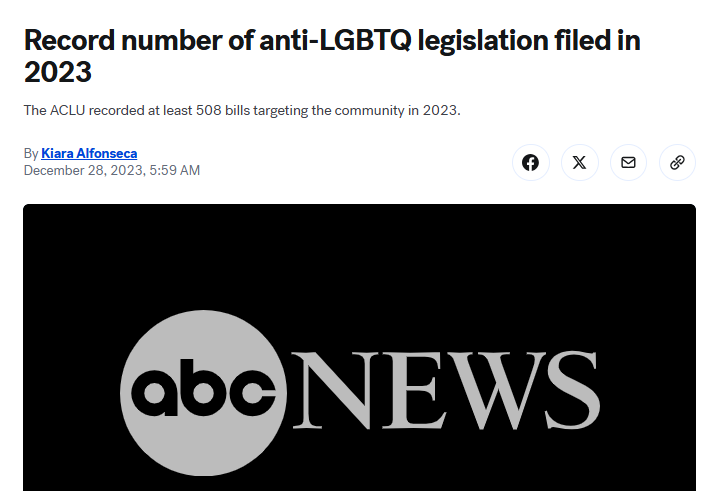
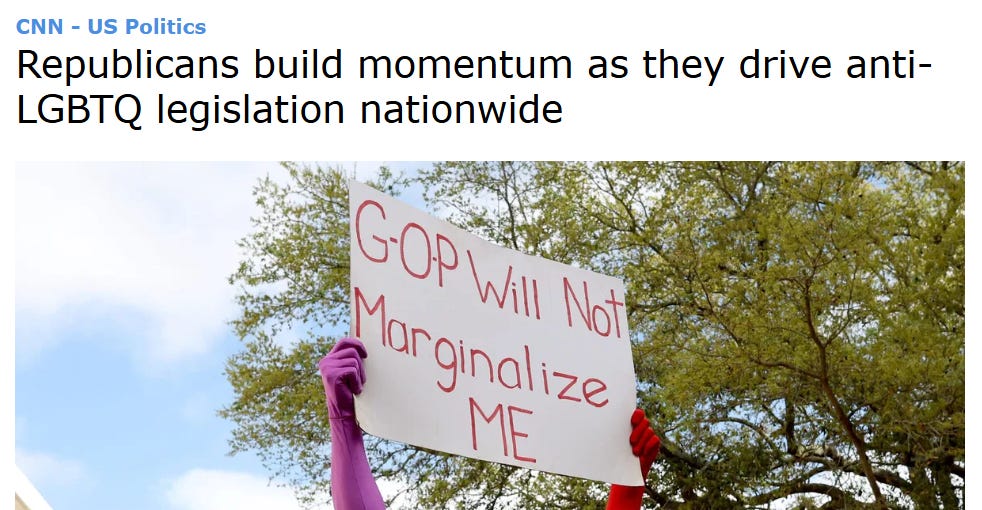
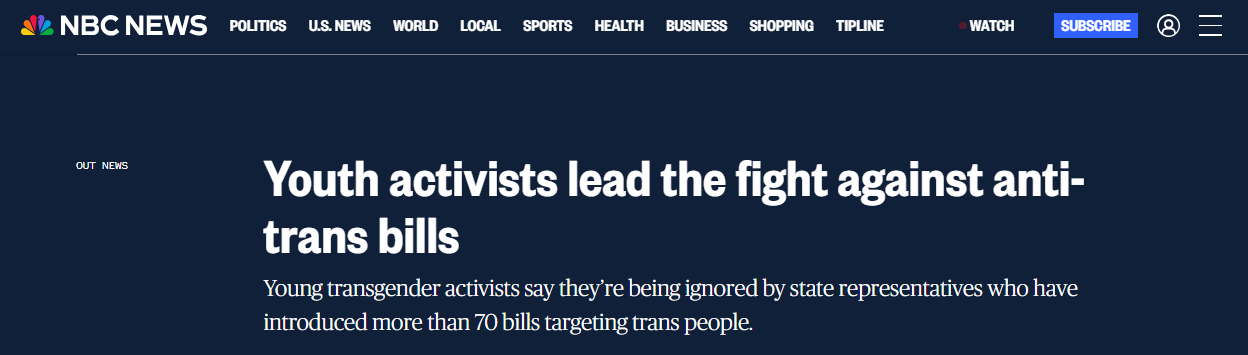
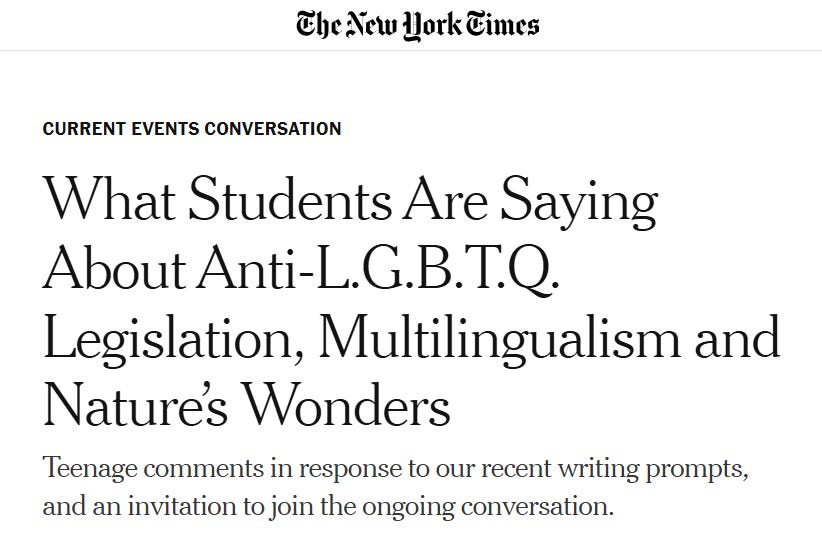
So the new, dishonest terms are smuggled in, and they are used to construct and polish an image of unreality. Returning to gender ideology, how many leftists oppose laws aimed to reinforce sex boundaries in K-12 sports as an attempt to “take away the rights of trans people”? How many articles exist with the repeated use of “anti-trans” or “anti-LGBTQ", even though the supporters of these bills are not anti-trans or anti-LGBTQ and they would not assent to these descriptions… and the bills don’t take away any civil rights or equal protections of trans people.

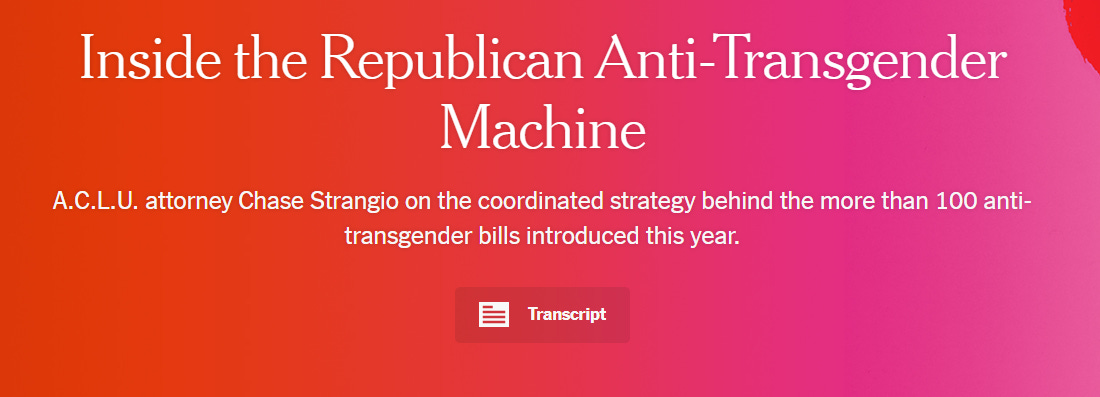
Chase Strangio is an interesting case. He was actually forced to concede (before the U.S. Supreme Court, a venue where intentional deception and factual conflations are always a risky strategy) that there was no firm scientific evidence that ‘gender-affirming care’ (sex modification surgeries) for minors had positive impacts on their health or long-term suicide risks… or anything really. This is the kind of detail that an honest person should really lead with, when discussing these issues, but it required intense questioning by Justice Alito. Strangio tried to conflate short-term subjective measures of mental health (mood, anxiety, etc.) with suicidality, and suicidality with suicide death risk but he was eventually forced to admit that, in fact, there is no reason to believe that gender-affirming care is effective in “saving trans kids’ lives.”
Chase Strangio: What I think that is referring to is there is no evidence in some—in the studies that this treatment reduces completed suicide. And the reason for that is completed suicide, thankfully and admittedly, is rare and we’re talking about a very small population of individuals with studies that don’t necessarily have completed suicides within them.
So the central claim of trans activists in regards to pediatric medicine is spurious. Just an interesting aside…
Read more by Leor Sapir below:

What these bills do do is they forbid trans minors from choosing which sports league (boys’ or girls’) they will play on. No one (not a trans activist, certainly) would ever resist attempts by a gender dysphoric boy to play on boys’ sports teams. But because that boy has gender dysphoria (and might see themselves as a girl, and wish others to see him as such) he is to be given the option of playing on girls’ teams. In fact, because there is not firm definition for what a ‘trans’ boy or girl is (no objective markers, and not even a firm conception in progressive spaces, where non-binary or ‘gender-nonconforming’ people are often called ‘trans’, despite not feeling themselves to be members of the opposite sex), the absence of these so-called “anti-trans” policies mean that effectively any child can choose which sports team to play for. In reality, of course, this is a privilege mostly accorded to boys and girls who ‘present’ as the opposite sex. But forcing all children to play according to their biological sex isn’t discriminatory or anti-egalitarian. It is the very standard of civic equality! ALL children will play on the sports teams of their biological sex. It’s fair, it’s sensible, it avoids confusion and offense and safety risks… and it worked for the past 100 years (until about a decade ago).
Only an activist (i.e., a person who never played sports and has no interest in children’s sports, other than as a vehicle for radical social change) could be dissatisfied with that status quo. Yet it is the activists who have crafted our language, and it’s the media (and the cultural creators, and the universities, and a thousand high-status professional cowards across the political landscape) which has reflected and repeated their new terminology.
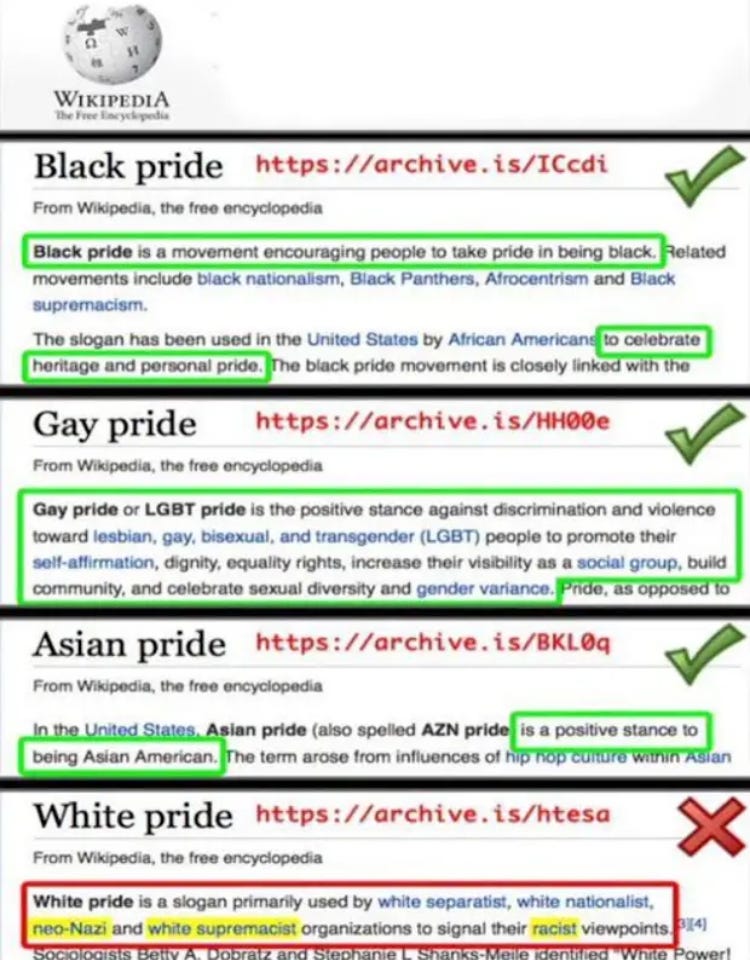
So. Let’s avoid all of that. Let’s be clear about what racism and white supremacy mean, and what they don’t.
Definitions and Qualifications
Racism is the idea that a race (or races) are innately inferior in some way. This belief often leads to unkind or discriminatory action against the race(s) in question, and so any negative stereotype applied across the board, any insult or offensive remark, and any act of threat or hostility or violence can be accurately called ‘racist.’ It must be emphasized that racist ideas are usually treated in the West as if they’re manifestly untrue. Racism is harshly proscribed in our society (anti-black racism, at least) and so many well-meaning and midwitted individuals act as if calling something ‘racist’ invalidates it on its face. That epistemological shortcut has led ever more ideas and attitudes and polices to be labelled ‘racist’ by a managerial class hungry for power and disdainful of dissent. But the United States (which, unlike Europe or Canada or Australia, had an actual, widespread political structure of white supremacy well into the second half of the twentieth century, although even then it was weakening and crumbling) came to socially penalize anti-black racism so vigorously because of a growing understanding of injustice, which was hijacked by the eternal liberal enthusiasm for egalitarian social engineering.
In other words, we never discredited racism as an idea (it’s too broad and applicable to ever be so discredited in every respect, probably). We simply collectively decided, shepherded by a progressive media and academic complex (what Curtis Yarvin has called ‘the Cathedral’) that anti-black racism was socially maladaptive and would henceforth be discouraged. Note that the very fact that our society, led by an unusually-unified elite class, made this decision is a kind of refutation of the idea that anti-black racism is an ongoing feature of the social structure. We’ve now had at least four generations of high-status cultural creators and financial managers and policymakers who earnestly want to assist and empower the category of ‘black people.’ Where exactly is the structural racism in this scenario?
In cultural terms, the period which served a transitional between racism being basically universal (only repudiated by the most utopian and radical thinkers) and being reputationally disastrous was very brief - perhaps 20 years. By 1980, no mainstream American politician or cultural institution or celebrity would or could be openly racist against black people. As time has passed, that pressure has become even more intense. Meanwhile, the long list of institutions and organizations (law firms, nonprofits, consultants, university administrations, etc.) which need anti-black racism to survive as they are has not diminished. It has actually grown apace since 1964 (the year that the Civil Rights Act was passed). Consequently, racism - despite being more harshly penalized and more embarrassing, and therefore much rarer in public - cannot be seen to have declined or be declining. Fortunately for the racism-managerial complex, there remain profound disparities between the categories of ‘black Americans’ and ‘white Americans.’ These disparities are often offered as if they are, ipso facto, evidence of racism. One doesn’t need to think very long or very deeply to see the fallacy here. Is the overrepresentation of men in the prison system evidence of misandrist sexism? Is the relative success of East Asians in the United States compared to whites evidence of anti-white racism? If not, then disparities cannot be sufficient to prove structural discrimination, and more exploration is required - exploration which the racism-perpetuators are never quick to initiate.
Then of course there’s the growing hostility towards white people in our cultural spaces. That’s a subject for another essay, but it certainly erodes any claim that these spaces are anti-black. They are, if anything, only anti-white and very much pro-black. Therefore, they cannot be supposed to be contributing to “white supremacy” in any meaningful sense.
The Scapegoat

Our culture often tolerates and even encourages hostility and disdain toward straight white men (or men, or white people, or straight people). This is a gleeful and socially celebrated habit in many spaces and it’s a bad thing, more for the haters than for the SWM.
So: (anti-black) racism was a major cultural factor and now it’s very minor one. As racism receded from public existence, those who needed racism as an extant social problem to justify their status and their funding (and those who lean on it as an explanation for black failure and selfishness and weakness and antisocial behavior, being unwilling to consider any of the more direct and plausible explanations) loosened the definition and eliminated the natural moral gradations. The same thing happened with #MeToo. Committing racist violence is very bad. Saying hateful or threatening things is also very bad but probably less so. Making unkind and unfair statements about black people is less bad still. Making off-color (pun intended) jokes can be pretty rude but isn’t of the same magnitude as the preceding kinds of acts and words. Touching hair, misunderstandings, and asking people where they’re from or mispronouncing their names (or saying non-racial, indeed non-English, things that might sound like racist words) simply isn’t racism at all in any meaningful sense.
Racism Hoaxes

An essay in which I give a rundown of the never-ending sequence of racism hoaxes and what they might reveal about our society.
To justify this elasticity of faux indignation, a number of also-false concepts have been attached: intent is irrelevant, only effect (which is completely incorrect according to any sensible and consistent ethical system); black people already suffer as black people in the United States (incorrect; some do and some don’t, some are privileged and some are not but race is almost never the primary determinant of people’s status in American society); black people must perform ‘emotional labor’ or are grievously wounded by misunderstandings or mistakes (people can be wounded by all kinds of things, but if someone meant no offense and they apologize then the offense should be purely a matter for the offended party to resolve personally). These glaring fallacies and more, which contain ethical principles that are never consistently applied, and are only used in these narrow circumstances to gain status for black people and to contribute to race hysteria, can be added to the popular misconception on the left, and among young people, that black people can’t be racist. This is done by redefining the word ‘racism,’ and pretending that black people have no individual or collective social power. Black people can hate or mistreat or aggress against others primarily due to their race and they can therefore do tremendous (unjustifiable) damage to others. If you are unwilling to call that kind of thing ‘racism’ then you’ll need a different word. But it must be called something because it exists and it must be discussed and dealt with.
And of course everyone knows all of this. The impetus behind pretending that black people can’t be racist (so, in societies like Zimbabwe, where the power structure is black, does this mean white people can’t be racist?) has nothing to do with epistemology or social experience - it’s purely a Critical Theory-driven attempt to focus all organizational energy and attention on one variety of racism. This isn’t because CT (or CRT) is against racism per se. It’s because the entire ideological structure wants to transform society into something unrecognizable, and the flaws in our society (the potent historical guilt around anti-black racism) are pressure points, useful for this goal. But this guilt, and the mammoth efforts at reform in the past half-century, are themselves repudiations of the idea that we are an anti-black society. How could we be, with so many powerful people concerned with anti-black racism?
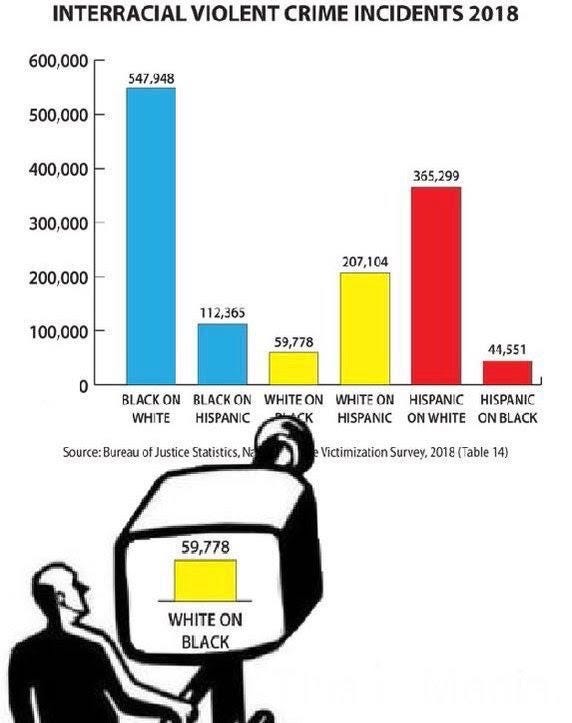
So racism continues to exist (has always existed, will always exist) but has been intentionally distorted and redefined in order to serve ulterior political ends. Racism is the idea that a race (or races) are innately inferior in some way. It can be reflected in jokes or faux pas or insults but it is really a deeply-held belief. And it has not been disproven. Anyone who wants to weaken racism - really weaken it, and not just punish its expression - would focus on disproving or eroding racist ideas. Ironically, our culture is profoundly unwilling to do that, because attempting that would require us to verbalize and respond to such ideas. Instead, we maintain an awkward and contradictory dual stance: racist ideas are simultaneously ridiculous and unworthy of even being articulated… and they are so dangerous and virulent that they can never be stated. We see this fragmented approach everywhere in race politics in the United States: black people commit more crimes per capita than white people because of historical or contemporary racism (for example)… and pointing out that black people commit more crimes per capita (far more) is itself akin to racism. So racism is the proximate cause of the problem and noticing the problem is itself also racism. It’s racist for people to mention “DEI hires", but DEI programs are important policy instruments which have presumably influenced the hiring of many people (or else what value could they have?). White people moving out of a black neighborhood is “white flight.” White people moving into one is gentrification. Defining a black person by their race, or asking where a nonwhite person is from, or assuming that they have a certain background or perspective is racist. Failing to center “black voices” (a formulation that presumes that black people have a certain unique background or perspective) is also racist, and racial diversity is important because it will improve the performance or creativity of a team/school/workplace, a notion which (conditionally) defines the black participants by their race.
It’s a mess. Of course, there’s no way to raise or discuss any of these issues honestly. That universally understood commandment of silence is the progressive norm that holds the entire rotten, antisocial structure (which has certainly not benefitted black people) together. Surely mentioning these glaring inconsistencies is not itself racist? But it’s often treated as such. In truth, in elite spaces now any idea or question which erodes or casts doubt on the progressive orthodoxy is now ‘racist,’ even if it benefits or empowers black people. School choice is racist. Studies which show that black students can outperform their moribund public school counterparts (given proper teaching incentives) are racist. The notion that problems in the black community are due - at least in part - to the programmatic erosion of black marriage and family structures is racist, even though it explicitly repudiates the idea that racial disparities are due to some innate quality, instead displacing a great deal of cause onto national policymaking and the values of the wider society.
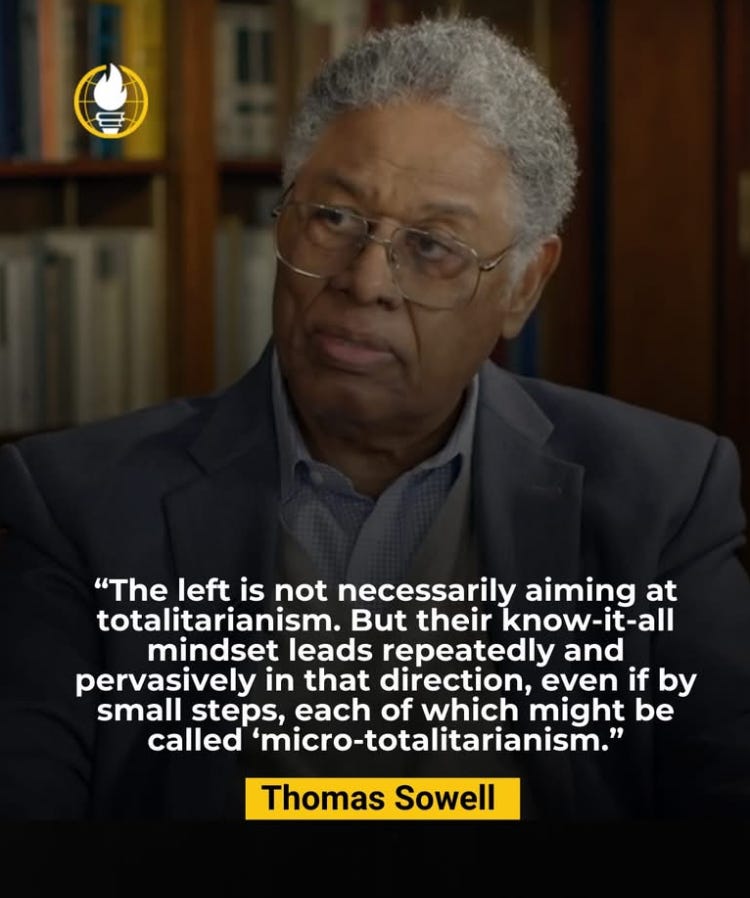
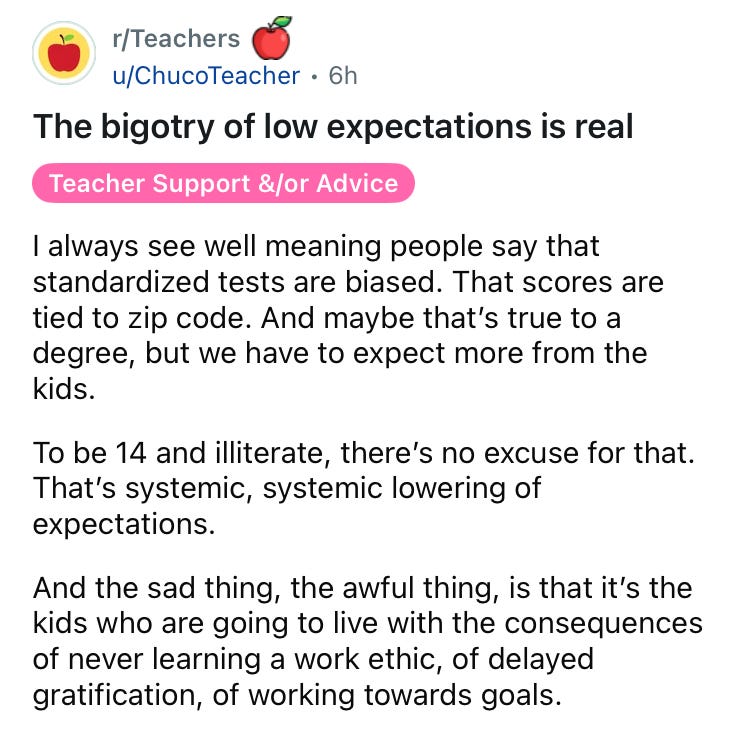
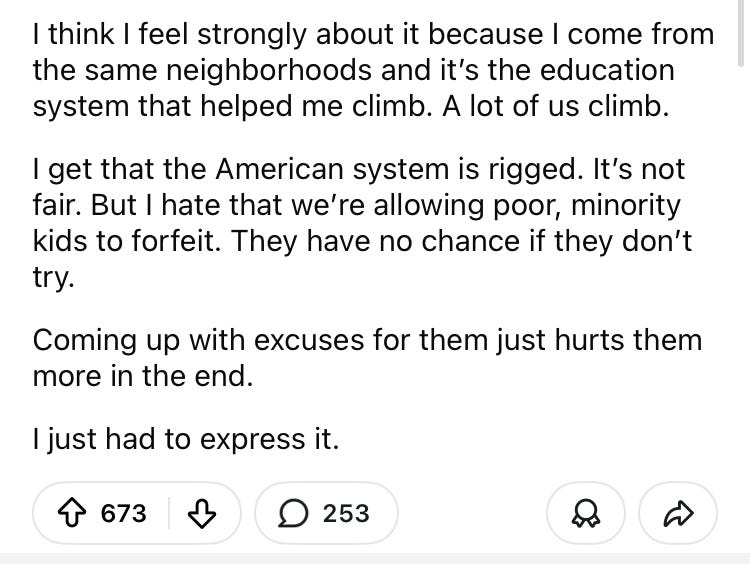
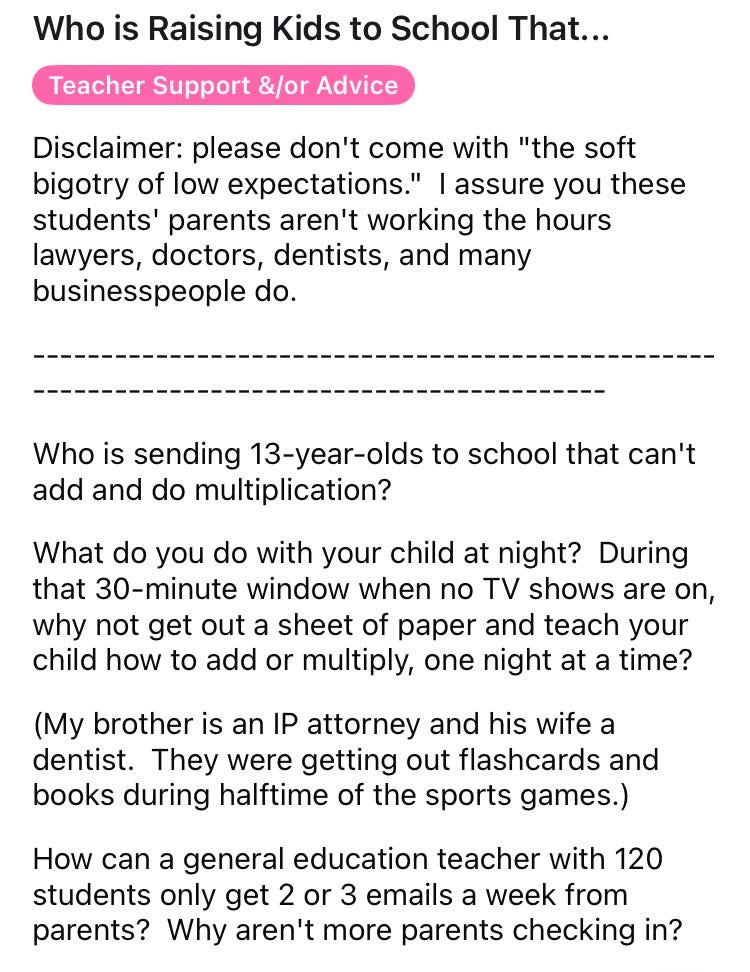
And that last clause is the instructive one. The dominant progressive race narrative is not, at its deepest, a sincere expression of beliefs about black Americans and still less is it an expression of goodwill for them. It is a concerted attempt to deny blame for progressive policy failures and to protect the narrative at the expense of the black community. The claim that ‘systemic racism’ is the proximate cause of black lagging and failure is not a counter to the idea that black people are innately inferior. There are people (black and white) who believe that black urban culture is in certain respects pathological or that black people have been collectively diminished by entitlement programs and the bigotry of low expectations, but there’s very little discourse (that I have seen) that suggests that black people are innately and substantially inferior (we will discuss IQ shortly). The progressive race narrative is not an answer to a popular belief in black inferiority and it’s not a defense of the overall equality of black achievers. It is instead an answer to the very credible and nagging possibility that the disparities we see (in education and income and orderliness and family integrity) have been created - or at least badly worsened - by the white power structure and by progressive policymakers. The progressive narrative concerning the state of black America isn’t really about black people at all - it’s about progressives, and their ideas. And the idea that massive continuing entitlement programs and administrative machinery are required to uplift the mean value of black achievement (not a belief that someone who believed that black people were innately capable is likely to have) has an added bonus: it continues to justify enormous levels of funding and activity for the administrative state, which is progressivism in the modern world - the very same administrative state which has done so much lasting damage to black families and communities during the past century.
There’s one comment about ‘equality’ which I feel I must make here: equality in the American context used to mean a kind of spiritual value. It was a recognition that all adult citizens in a democratic state had some basic right to participate in the political affairs of the society, and that they had a right to consideration under the law and protection of basic rights. It did not mean that every group was equally capable in every respect. Stated in this way, the claim is absurd on its face. There are endless debates in leftist spaces about the validity of IQ . These debates are full of the familiar strains of contemptuous, false certainty which lingers around all leftist discourse (“IQ has been completely debunked”) but if we step back - even slightly - from the frantic midwittery of trying to erase a century of psychometric data we can completely sidestep all of the arguing and intellectual dishonesty. Would an employer rather hire 10 people with a mean IQ of 110… or 10 with a mean IQ of 80? Would a college rather admit the former group to its student body, or the latter? Would you rather live in a neighborhood inhabited by the former, or by the latter? Anyone who answers these hypotheticals honestly has conceded that, on average, IQ does in fact matter.
And black Americans have, on average, lower IQ’s. That’s the kind of rancid and impolite fact which fatally wounds so many liberal pretensions. It’s undoubtedly impolite because it’s not the kind of thing black people would like to hear but it’s not a forbidden fact solely on that basis. It is forbidden because it destroys the narrative of equal outcomes, which was never a part of the democratic social contract before the imposition of modern progressivism. Black people having a lower mean IQ score (~86, compared to ~101 for white Americans) is nothing but a mathematical abstraction. The difference is substantial of course but in an individualistic society it needn’t be fateful or determinative. You have the IQ that you have (which is a completely separate value from averages yielded by huge sample sizes and categorized based upon race) and you can add to its potency by developing social skills or discipline (or diminish it through impulsiveness or laziness) and you will rise as high as you will rise. Group averages only become important (they’re only relevant at all) when group performance starts to become a social project, and that is primarily a hobby of the progressive left. When people claim that a dearth of surgeons or airline pilots or software engineers is somehow an indictment of the social structure or the selection mechanisms (without ever providing any details about how those mechanisms could be improved aside from “choose more of x group”) then they have raised the issue of group metrics. Why would anyone ever mention mean racial IQ scores? Because there are legions of collectively powerful ideologues - that have captured universities, the culture, and the Fortune 500 - who are claiming that racial disparity equals injustice, and that this injustice demands a massive and civilizational redress, even if that means that millions of less qualified applicants are selected and more qualified ones are shunned.
Is it racist to say that black people in the United States are, on average, are not as capable of being college professors or civil engineers? In the current zeitgeist that is definitely racist (even if it’s also demonstrably true) but that fact says more about the culture than it does about the people who might reluctantly point out such facts. We can embrace the traditional American ideal of equality - an abstract civic and spiritual quality - without becoming committed to the (ridiculous) idea that every large group is as qualified to perform various high-status tasks as every other. Disparities are not necessarily (and are rarely actually) an indication of racism. Are the overrepresentations of South Asians in medicine or Jewish Americans in psychology or women in HR leadership pieces of evidence that point towards Asian or Jewish supremacy, or institutionalized misandry? If these concentrations aren’t prima facie indications of racism or sexism then no concentration or disproportion is such an indication. To make a case for ‘institutional racism’ we need to interrogate the motives and beliefs of the people who control institutions and dive into the precise hiring and training and promotion dynamics. But equitarians rarely want to do this. That reluctance has a definite cause: there’s almost no solid evidence in the modern world of racism as a primary generator of the many racial disparities we see around us.
In a moral sense, the generation of statistical averages or generalizations cannot be the forbidden and strictly proscribed act of wrongthink that it is often regarded as by contemporary elites. There’s one nagging qualifier which makes this kind of taboo coercive and ultimately unsustainable: many of the generalizations that we find in data are true, even if they reflect poorly on black people or other designated ‘victims.’ When confronted with this fact, progressives will immediately pivot and blame the statistical disparities on structural racism but even when this explanation is sufficient (which it probably is rarely, in toto) it can’t be assumed in the way that it is in elite spaces.
The well-worn shape of these exchanges is dictated by modern proprieties and the exquisite sensitivity to status and progressive orthodoxy among the managerial class. It has very little to do with social reality or logic.
White Supremacy
If racism is the persistent and malignant belief that certain racial groups are innately better or worse than others, then white supremacy is the ideology of racial hierarchy - of an enforced social order with whites at the top. Racists might tend to believe that white people are better than other groups (black people being the natural alternative in the flattened and artificial worldview of the modern American progressive) but white supremacy wants this distinction encoded in law and in status signifiers and observed in economic relations. A racist might believe that black people can’t rise to parity - that they simply lack the resources or character. A white supremacist wants this perceived hierarchy reflected in social structures, so that black people are actively disenfranchised and disadvantaged. I’m not a historian, but knowing the small amount that I do about the United States in the 1950’s and 1960’s I believe that it’s likely that, even in the 1940’s American South, that the energy behind white supremacy was already quickly diminishing, eroded by the values of the liberal order and the demands of modernity, plus the cultural pressures and opportunities of new technologies. Racism was no doubt common, even normal, but the desire to sustain the structures of segregation and institutional discrimination might have been waning. If that was the case then (and it certainly was within a generation) then how much less must the desire be in our era? In a time when the only discrimination and the only policies of segregation are explicitly made to preference and comfort black people, when trillions of dollars of aid flows into this racial category and when being black is a huge advantage when competing for college placements or corporate promotions, when the entire cultural production complex has essentially been captured by the ruthless logic of ‘representation,’ and grifter midwits like Robin DeAngelo and Ibram X. Kendi make many millions of dollars off of contrite and masochistic white people… in such a time how much appetite is there for white supremacy?
Here’s the thing: I’ve spent a LOT of time in right-wing media spaces.
In that time I have heard a lot of ideas and claims which might be considered racist by progressives and symbolic capitalists and members of the managerial class. We’re all familiar with what I’m referring to: speculation about maladaptive culture or the importance of (and lack of emphasis on) education, the pervasiveness of gun crime among young urban black men and boys, a focus on the devastating social impacts of one-parent homes as a default family model.
I’ve even heard some ideas which could be called ‘racist,’ in the sense that they speculate as to the innate (mean) inferiority of black people in the United States (or globally) in some respect: the genetic factor of IQ, global cultural weaknesses (a supposed neglect of maintenance, or a tendency towards corruption, in black societies everywhere), speculative narratives about civilizational features or the links between race and culture.
But what I have never encountered - not once - is white supremacy. I have run into distasteful jokes about black people and unkind racialized terms and a kind of persistent exasperation at the persistently disastrous symptoms of social pathology (academic failure, gun violence, illegitimate - in every sense of the word - births, generational poverty, obesity, impulsiveness… the wholesale cultural wastage of human potential year after year) but I’ve never really heard anyone call for the nullification of the 15th Amendment, or the re-institutionalization of segregationist state laws or the re-criminalization of miscegenation.
It seems to me that our Overton window on racial issues have been pushed so far leftward by progressives during the past 70 years that we have all silently assented to their reframings. This is worrying, because their current ongoing cultural project involves defining meritocracy and the celebration of excellence themselves as white supremacy (an attitude which would have sounded confusing and perverse to the Civil Rights leaders of 75 years ago, and one which is distinctly unpopular in working class black communities). As I look over our culture I see two ubiquitous pressures: one to constantly redefine racism (and then simply call the newly-labelled racism ‘white supremacy), expanding its scope and making any slightly off-color suggestion or misunderstanding the moral equivalent of cross burning. The other is to constantly attribute the struggles and shortcomings of the black population to this nebulous and now absurdly loosened category of ‘racism’ (now ‘white supremacy’). The irony of this of course is that in a society in which either malignant racism or white supremacy were serious concerns this insane over-sensitization and misattribution wouldn’t be necessary.
That’s to say nothing of the flagrant and frequent missteps in the opposite direction, which are rarely remarked upon by the managerial class. Read the headlines below and ask yourself: is this a society infected with anti-black racism? Are these institutions really instruments of white supremacy?
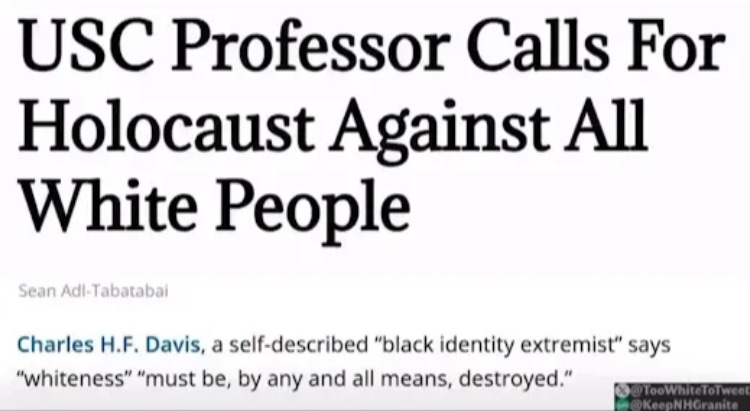
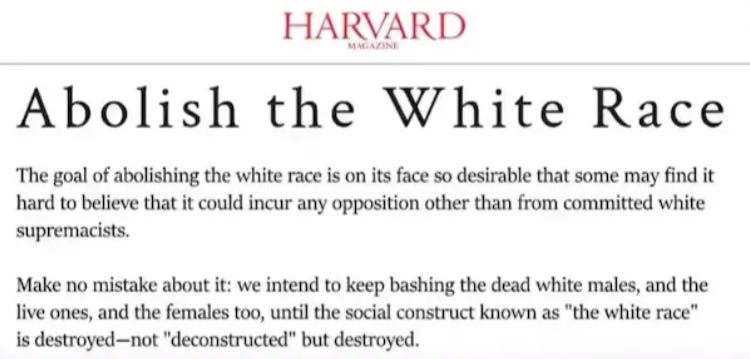
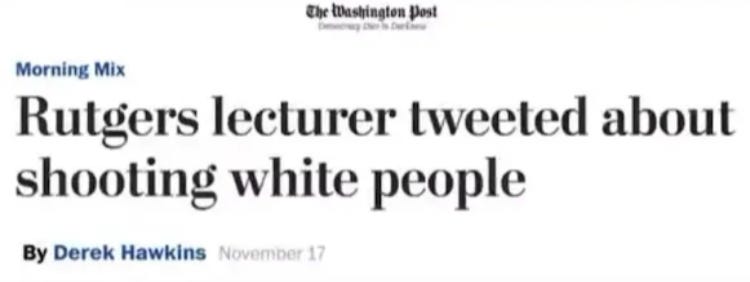
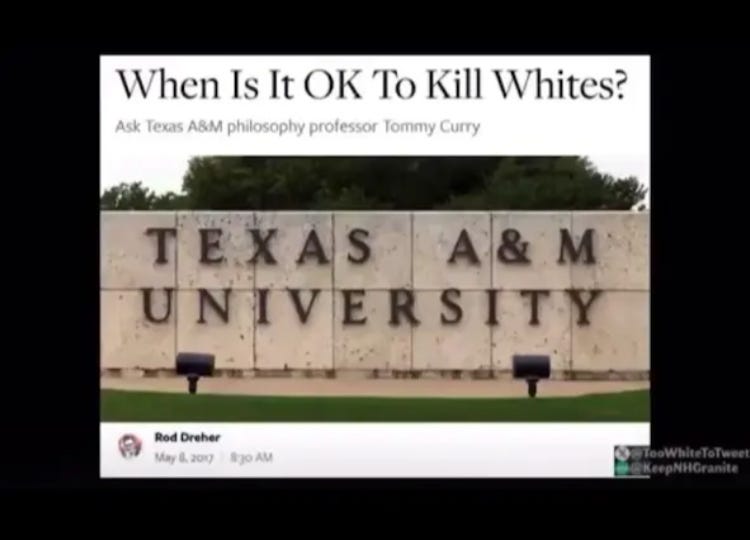
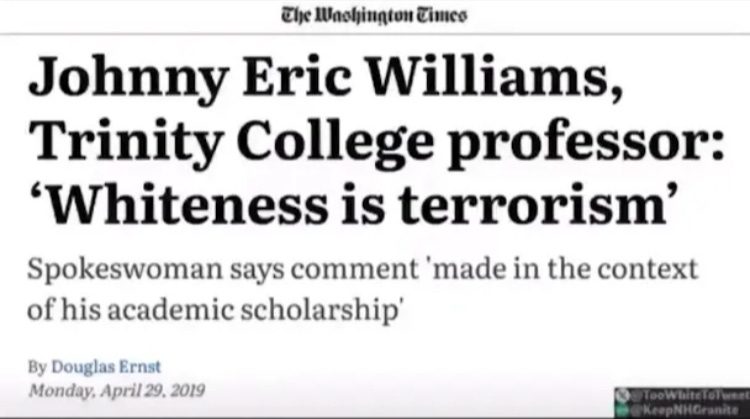
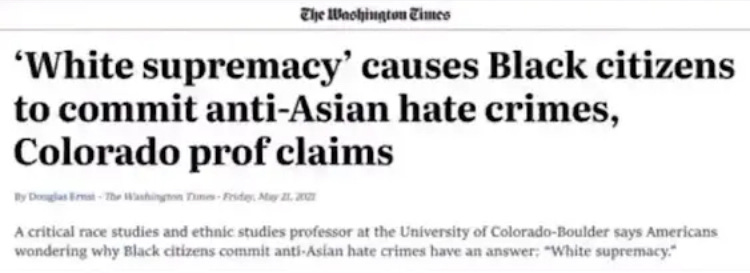
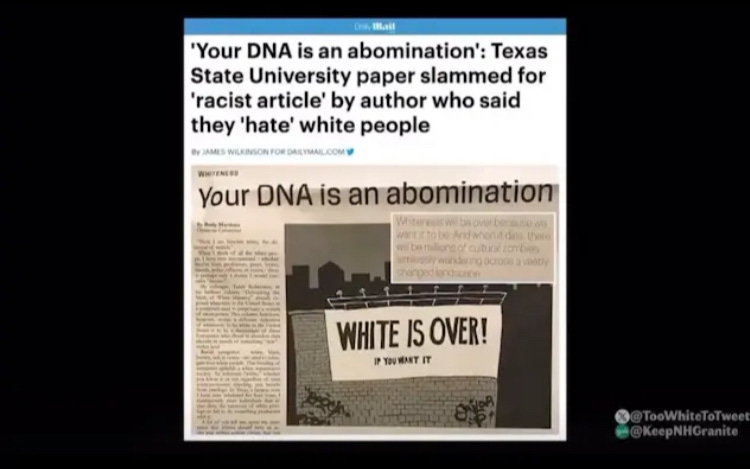
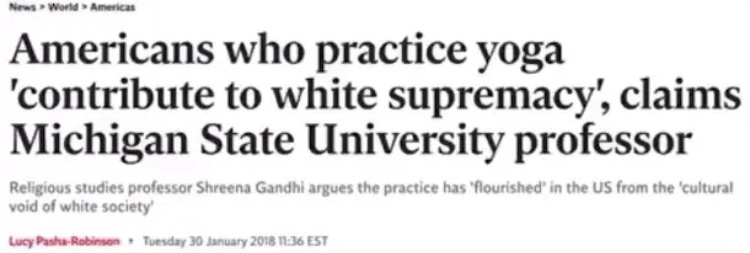
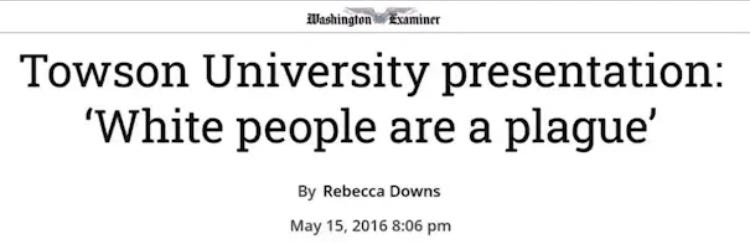
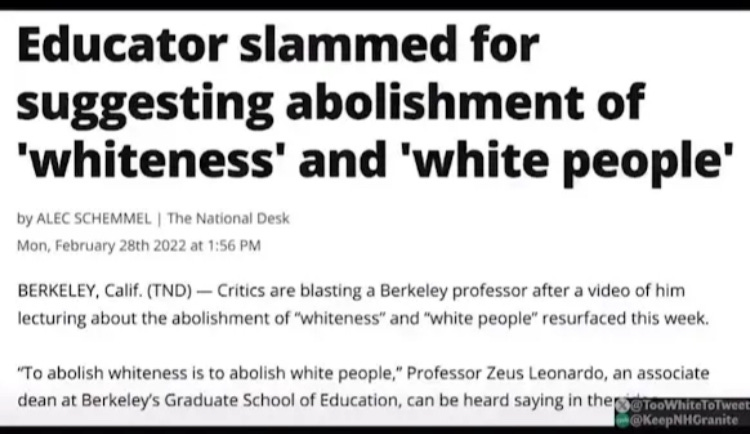
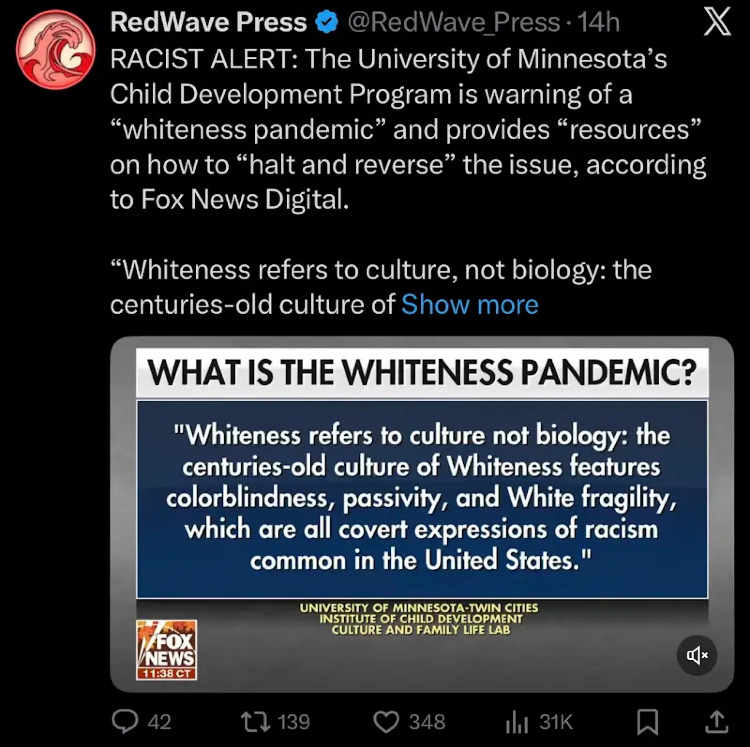
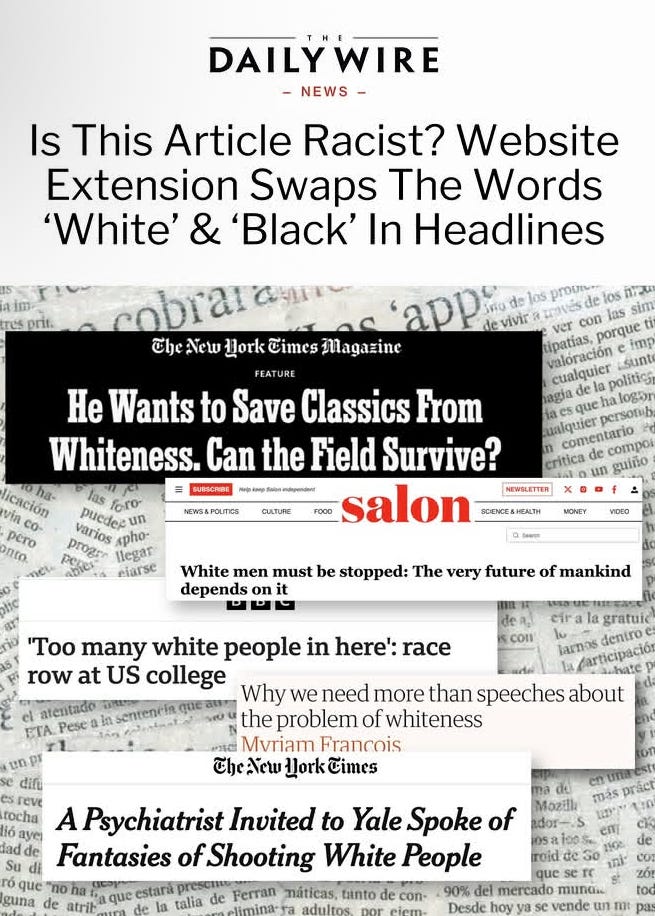
Take a case study. It’s unspecific but accurate. This kind of thing has happened dozens of times in universities and (to a lesser extent) corporations and nonprofits and agencies across the country: a white instructor or administrator missteps. It could be a joke, or a perfectly valid generalization, or even a misunderstanding. Whatever it is, the progressive activists sense their opportunity and they begin a pressure campaign: fire the professional in question, apologize, commit to hiring more “diverse” (not in terms of background or ideas or culture - only racially diverse) staff, and devote more funding to some purely symbolic institutional fixture. That latter item could be scholarships or a student lounge or a corporate training program. This is the masochistic struggle session cycle of the modern institution. Everyone knows it’s nonsensical on every level. No one really believes that the instigating event was a result of malignant racism. The offending people are contrite, apologetic, remorseful. They debase themselves, without any forgiveness ever granted. There’s never any evidence of them actually harboring any racist thoughts or ideas, but that’s irrelevant. Their friends and coworkers go silent. No one defends them, and they are inevitably terminated. No one really believes that racism is a major dynamic at the institution. If they did then surely they would point to the hiring process or policy or individual perpetuating the racism. That never happens. ‘Racism’ is instead used as a kind of magical incantation, a spell word used to win power and status for activists. It’s not meant literally, and no one understands it this way… but everyone plays along. No one actually thinks that the proposed solutions will meaningfully address racism, or that they will improve the condition of black students or faculty or workers. A student lounge? More hiring? A training program? The empty and specious nature of these proposals are definite indications of the silliness of the entire exercise. If there was some injustice or systemic disadvantage at play then surely these would be targeted. The awkward fact for the activists is that they are already members of liberal organizations which bend over backwards to validate their prejudices and promote their success. Even with these advantages and considerations, collective black success often lags or is illusory.
From this general example we can begin to see the truth: racism must exist, in order to explain black underperformance, and to justify activism and administrative interventions. Without any reference to reality or demand for evidence, a concept like “racism” naturally morphs into its more oppressive and malignant cousin, “white supremacy.” But there is little racism (and what little exists has no effect on organizational operations or individual outcomes) and white supremacy has been a thoroughly extinct force in American politics for at least 50 years.
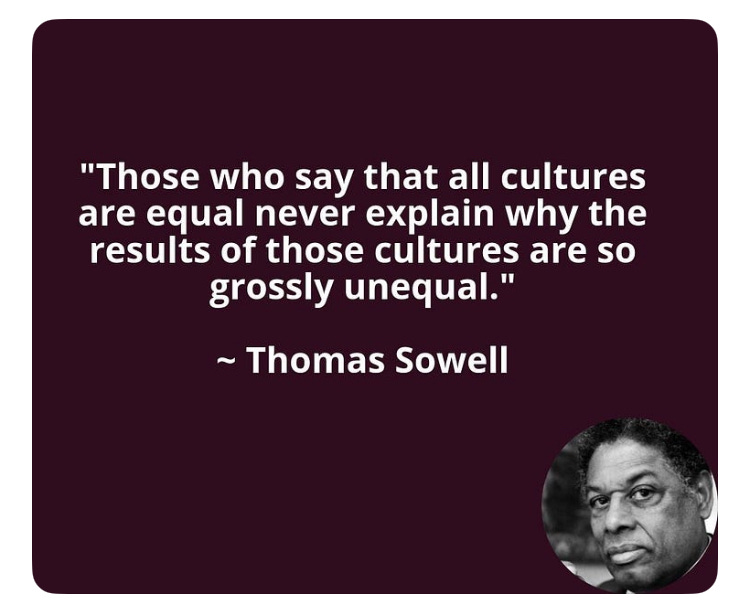
Here’s the devastating fact: if black students were as motivated and studious as their counterparts, if African-American adults were as amenable to marriage and law abidingness as the adults of other American subcultures, if black teenagers were imprinted with the same ambitions of college and professional achievement as their white and Asian fellows, then the structural advantages in place for them would be huge. They would be life-changing. As it is now they certainly enrich and advance many individuals, but these successes aren’t even sufficient to erase the massive disparities in social outcome. None of these anti-black disparities are rooted in policy or economic advantage or racial preference. They are all cultural. Like all cultural constructs they express themselves in the decisions and ideas and life courses of the individual members. In a country where every professional organization pays homage to thinly-veiled Marxist values like “equity” and “inclusion,” where the vast majority of white professionals feel some guilt about their own “white privilege” and actively desire the advancement of black people, and where virtually every institution of higher education blatantly and heavily discriminates in favor of black applicants, it is time to say the obvious: anti-black racism barely exists, and is no longer meaningful as an explanatory factor for black underperformance. White supremacy doesn’t exist at all.
Thanks for reading. Take care of yourself.

Similar Essays:
The Pathetic Mindset of the Black Bourgeoisie

This is a general observation about the pretense that I perceive among many black professionals. Obviously my criticisms don’t apply to all of the people in this category (as analyses of “the white working class” don’t apply to every white, working class person) but it’s a trend I see, especially in the culture. I doubt that black elites are generating the narratives I describe, but they’re participating in and assenting to them. And that’s a problem.
40 Acres and a Mule

To gain a louder voice black Americans will have to (collectively) leave the Democrat Party ‘plantation’. Only then will they gain the influence a group of their numbers and prominence in American history deserves. Right now they have probably been harmed far more than helped by the government in the post-Jim Crow era. Coincident with the black migration away from Democratic Party politics is a growing chorus of voices pushing back against victim mentalities and paternalistic narratives. These self-abasing ideas haven’t proven to be helpful to black America and they seem to be slowly dying, from the bottom up, and the middle outward.
Entitlement Culture

There’s an entrenched and harmful culture of entitlement and parasitism among the lower classes. This is bad for American society, and it’s bad for the recipients. It might even be so bad for them that the harm more than outweighs the benefit they derive from thousands of dollars of free food every year. That’s certainly the case in many instances.
White Supremacy

This is a series of historical questions and sociological speculations, including many of my doubts about the racial-historical narrative that many people want to turn into a kind of unquestionable moral orthodoxy.
Statuary

An essay in which I explore the implications of the infamous and divisive new statue in Times Square.
As a black man. I can confirm. White supremacy indeed does not exist. It’s down right disingenuous to believe otherwise. The excuse for White supremacy is a preposterous perpetual victimization mentality orchestrated by the Marxist leftist democratic party elite and persisted, preserved and goaded by elite black political, community and pastoral leaders within the leftist ideology. Promoted and propagandized by the media and the Hollywood elite. Are there racist whites? Sure, absolutely. Likewise, there are also racist blacks. The difference is one group is not only killing each other everyday in record numbers over petty crimes and disagreements. While simultaneously charading and parroting that supposedly black lives matter. While blaming another race for their inadequacies. They are responsible for the majority of the violent crimes in America and only make up a small fraction of the population while getting little to none incarceration time for it. While they listen to rap music that promotes black on black violence. Imagine that? Rhetorical. That’s some supremacy for you right there.
We must, must get rid of disparate impact as a tool or concept.