

Taskmaster - Part 1
A Year Spent Teaching Upper Primary Education

They inadvertently let an antisocial, masculine dissenter teach middle school Civics. How did it go?
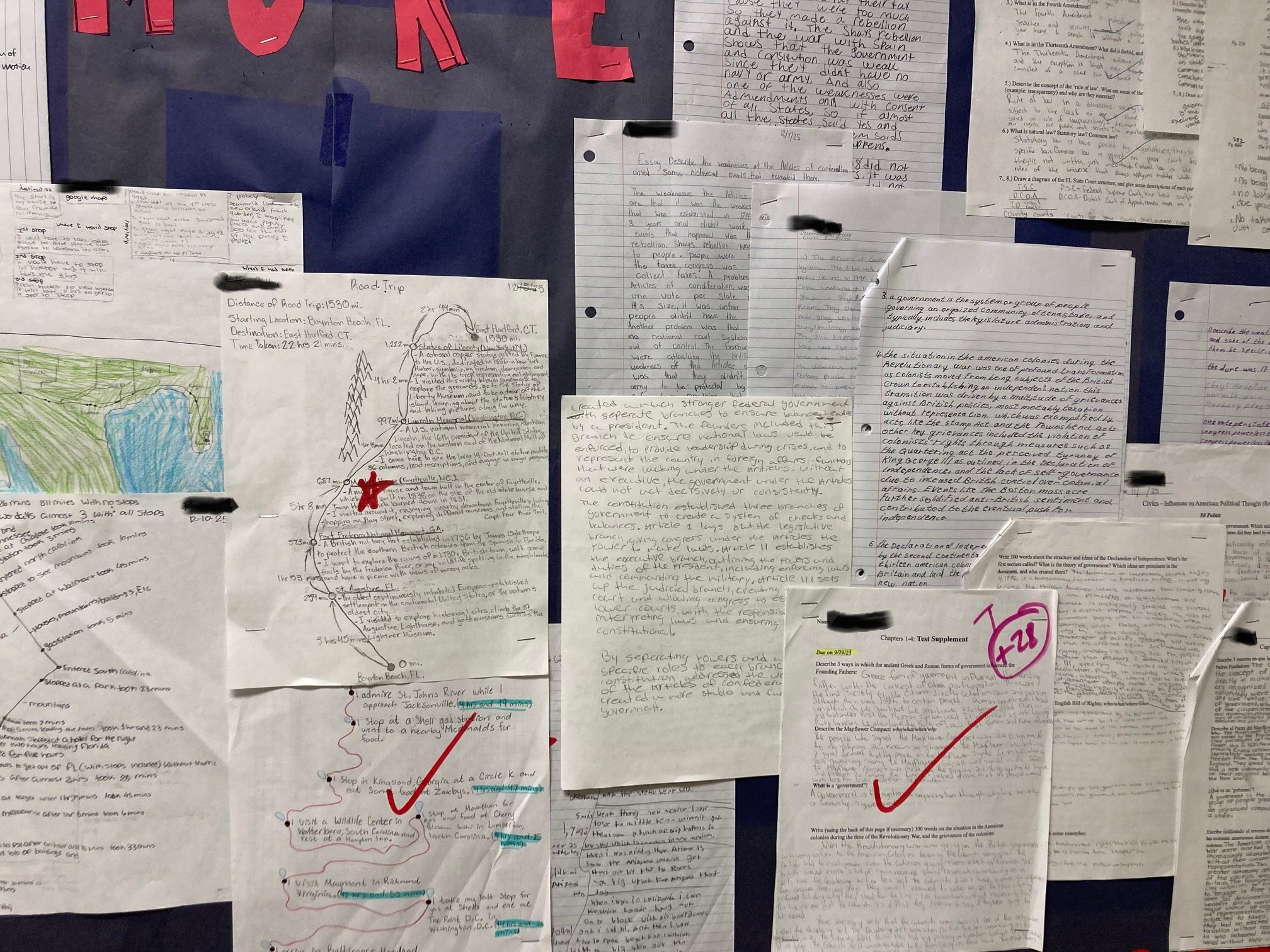
Most of these students had never filled an entire notebook page with written text in one sitting in their lives. By the end of the year they were writing 3-4 pages in 45 minutes, analyzing the drawbacks of socialism or trying to argue whether or not America is an oligarchy.
Part 1 - In the Belly of the Beast

I will never forget my first few weeks of teaching. You might think that teaching middle schoolers would be kind of fun: computer games, arts and crafts, hands raised. What’s the big deal? If you think that, you haven’t thought deeply enough. Imagine a small, unruly, somewhat hostile classroom full of 29 middle schoolers (every desk occupied, the temperature slowly rising with breaths and body heat) at maximum volume. Now: you have to explain to them the concept of “checks and balances” (and none of them even knows that J.D. Vance is the Vice President) and you must make them learn it, learn it well enough that they can write about it and provide real examples and relate it to other concepts.
Go ahead.
I had no experience and no academic training in education, although as far as I can tell such programs are thoroughly worthless. I had been fast-tracked into a provisional ‘Statement of Eligibility’ under a Florida law which aimed to encourage combat veterans and former first responders to get into the classroom (how about providing us with a cash bonus?). I had spoken to teachers in my family and social circle and sought the advice of our AI overlords to do lesson planning and come up with some activities. But the teachers I’d spoken to have all taken refuge in bastions of relative privilege (as nearly all capable white people tend to do) and AI provided me with some laughably fantastical suggestions (“put on a brief skit featuring the Founding Fathers!” Lame). I quickly apprehended that things would be different in my classroom. They could be dysfunctional (bounded by agenda board and lesson plans and iPad-based activities, without homework or written tests… “schooling as a fun game”) or they could be rigid and work-intensive. I chose the latter, which meant operating at cross-purposes to the training and the rules and the grading policies I’d been handed. This is the story of that year, told in three parts.
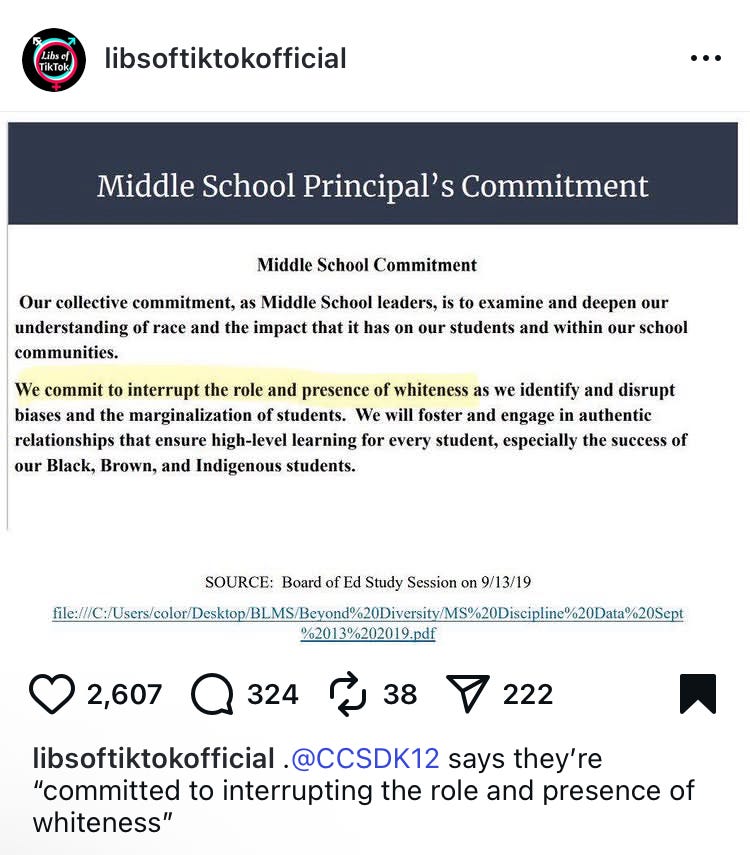
As an educator, I am anti-anti-whiteness.
Before I continue, I should describe myself - as my students see me. I’m 40 (Jesus) and I maintain a stern expression, even when saying ridiculous things to them (“No singing! no dancing in school! That’s an automatic write-up” or “you don’t need water, young man. If you lose consciousness from dehydration we’ll call paramedics and they’ll get you hooked up to IV fluids and you can resume classwork. No water break”). I’m muscular and I have a kind of uptight loping stride. I have a short haircut, tattoos, and nearly always have a thermos of coffee in my hand, patrolling the halls before class or during my work period with my face deliberately stern, trying not to laugh at the little ones as they call out “Hey Mr. _________!” and skip around the hallways. I’m sarcastic and gruff. I began the schoolyear generous with restroom breaks and nurse visits (which are really just spells in the front office, sitting in a dark little cubby near our receptionists and maybe getting some ice)… until I realized that I was being taken advantage of. I had to yell many times (what do you do when you’ve told a girl to sit down and stop bothering her girlfriend 3x and she’s deliberately ignoring you?), but far less towards the end of the year.
As for my students? Let me describe the things that matter to a teacher. They are messy and shockingly disorganized and inattentive. After class I would put the chairs atop the desks (so the floor could be cleaned by the evening crew) and I would find garbage - and by that I mean hundreds of wrappers, bits of paper, gummies, pencils, etc. Upon being assigned notebooks fully 1/3rd of the students lost them (which is why I was so reluctant to issue flashcards) and most never even bothered to retrieve them. They are so programmed to fixate on screens that any work which doesn’t involve their iPads (they have one in every classroom) doesn’t feel like schoolwork at all to them. Having a teacher get up in front of them and teach was alien; I would look around while I explained federalism or the Judeo-Christian ethical tradition to them and see 7 or 8 out of 29 kids happily talking to their friends of laughing, to say nothing of the kids who simply weren’t paying attention (most).
Most adults are probably picturing the grade school of their memory, with kids sitting in rows and quietly listening to the teacher talk or bending over their assignments, perhaps raising their hand every once in awhile. This is not that. I will go into the absurd and perverse behavior and grading policies that have now infected every layer and region of lower class education (driven by inoffensive but highly deleterious concepts like “equity”) in Part 2. For now let me just put it like this: if the students have an iPad they’re mostly quiet and on-task, even if the task isn’t one that you assigned. When you take the device away the din becomes a roar; students throwing things and calling across the room to their friends and leaving their seats. I can yell and I have a certain physical presence (I was an infantryman, and I’ve done combat sports for about 20 years now) but even for me it took weeks and lots of threatened and executed punishment essays and written tests (none of which are technically allowed in schools these days) to get my classes in line.
Here’s how I described my school (generously and in very general terms) in the last essay I wrote about teaching (Two Weeks In):
The school I teach at is full of cheerful, dedicated adults. The administration is (emotionally, less logistically) supportive, and the kids are not bad. I’m legally constrained from writing anything specific or negative about my employer (and I should be vague about exactly who that is) but in this case no self-censorship in necessary. It is a decent school, with motivated adults working there. The problems I see are largely due to culture and technology, which I imagine is the case in every school these days.
When you yell, the kids listen. When you threaten to call parents, they quiet down - at least until the next impulsive outburst or instance of horseplaying or poking. Those things are not to be taken for granted. There are many, many teachers in this country who have no power to remove students. No disciplinary threats move their pupils, and a call home is not just irrelevant but might kind of be an object of longing - that’s how little care and attention they’ve received from their caregiver (who is almost always a mother or a grandmother). These teachers can yell and punish and send kids to offices… without effect. After a few weeks of this, the shouting and scolding is seen for what it is: pleading.
That’s not the case in my school. The kids are rarely openly defiant and they do have some respect for authority (the fact that none are older than early adolescence surely helps). However, it’s still a challenging environment. Most of the students are from immigrant families, and some speak no English at all. Many have warnings in their file regarding custody disputes or DCF decisions. About 70% of my students are black. That shouldn’t be synonymous with behavioral and learning difficulties, but it often is and everyone knows that it is. Nevertheless, it is a joy to teach.
As I sit here I realize that it’s more difficult to describe the atmosphere of a classroom then one might expect. Everything I’ve written is true: it’s a pleasure to be in front of a classroom, teaching and joking with and disciplining middle schoolers. It also requires the patience to endure a lot of bullshit, more than I can express to you here in an essay. Tolstoy famously said that “All happy families are alike; each unhappy family is unhappy in its own way” and much the same thing could be said of a classroom atmosphere: every well-behaved and studious classroom feels similar; dysfunctional classrooms can vary wildly. And the classrooms in my school are dysfunctional, in the way that the bottom half of public schools across the United States are now consistently dysfunctional. If you give the students games or candy or iPads they will quiet down and even focus on the task at hand. If you try to get up and teach or instruct them to analyze a text or to take notes or (horror!) write an essay you will encounter resistance. This resistance is constant and low-level (it doesn’t usually rise to the level of write-ups or even serious scolding) and it’s often not even malicious. Many students don’t know how to learn difficult things in a sustained way. Even their “education” has mostly been a series of tablet games and kinetic activities and bright colors and clapping and cheerful, overfed, midwitted women exhorting them to contribute and showering them with spurious praise. It’s better than nothing, but when it comes time to sit down with a challenging book or to work through a difficult logical puzzle or to formulate counterfactuals or hypotheticals in an argument the students are lost. Nothing that they have been given, in today’s relentlessly sunny, supportive, feminized, (dysfunctional) educational landscape, prepares them for these eventualities. So they get restless, they make jokes, they yell insults at the girl across the room, they furtively throw trash at the can in the corner. I walked into education wanting to give my students a bare shadow of what I have: the ability to read difficult source materials, take notes, analyze arguments and access their own thoughts, and write - write at every step of the process. I wanted to begin to teach them how to access the wealth of knowledge contained in books and to learn on their own. Even if I didn’t teach them much civics, I thought, I could at least begin to pile up practice in this area. And even if they didn’t learn much about reading comprehension or note-taking or analytical writing, I reasoned, the very act of forcing them to engage in boring and difficult activities (and nothing is more boring and difficult and deeply hated by them than writing) would have some value in building discipline.
‘Discipline.’ That’s a word that you will rarely hear in school these days, much like you’ll rarely hear ‘courage’ or ‘honor’ in mainstream culture. And why would you hear it? The teachers aren’t disciplined. They’re overweight, in credit card debt (as am I), addicted to their phones. Many are single mothers, never haven taken accountability for their errors in decision-making or the negative externalities that society will accordingly have to bear. Discipline arises from the idea of some external standard or ideal, some regime that one has been agreed to bind oneself to. It’s still around of course, speckled throughout society, but it’s not developed or encouraged by our institutions in the same way as it once was. Parents with high expectations (speaking frankly, there are few of those with children at my school) maintain academic discipline in their kids. Athletes adopt physical and training disciplines. People who want to lose weight might discipline their diets (or try)… but all of this is instrumental, conditional. And none of it encompasses my school. There used to be, I believe, an idea of student discipline in schoolwork and behavior, some external standard that students weren’t good enough to meet but could, eventually, with sustained work and focus. That idea has been replaced by the (maternal) idea of support. Kids are there, they’re already wonderful and special (and they are, but they’re also lazy and distractible and shallow and deceitful and dull and conniving) and all we have to do is provide the lessons. Make them fun! Vary your strategies! Employ small groups and get them moving! Entertain them!
I do not connect with that educational philosophy. I think it can be suited for well-socialized and agreeable and conscientious students (especially girls) but I don’t think it provides the necessary pressure to mold students into disciplined learners. I chose to go in a different direction.

The national educational philosophy seems to have shifted (along with our culture) away from prizing achievement and pushing students towards difficult excellence, and towards equity and enforced mediocrity. And these days, mediocrity often isn’t even achieved - it’s just plain failure, regardless of what the gradebook or diploma says.
I walked into school determined to entertain no one (at least as a teaching strategy) - to employ primarily “old-school” methods (reading, not-taking, flashcards, essays) and to use every means at my disposal to create a regime of discipline that might make me unpopular or earn me resistance, but which felt like the only thing I could do as a writer and as a man… and as a teacher.
More than two years ago (before I’d ever made any preparations to become a teacher), I wrote:
The paternal orientation values achievement. It creates standards (high ones, if possible) and then expects people to live up to them, or pay the costs. It demands logical evidence for arguments and tends to support free speech (in the liberal context). It is concerned with establishing rules and following them. It demands standards of behavior and punishment for violation of those standards. It takes inequality and suffering and offense as unavoidable aspect of life which have no bearing on the rules. The rules are written to help society: build, defend, compete, thrive. This is a muscular orientation which leaves feelings to be managed by the individual and does not try to ameliorate inequality to make people feel better or to increase fairness, although it might do it help society build and thrive. Capitalism, logic, modern warfare, the criminal justice system pre-1970’s are all paternal models.
The maternal orientation values unconditional love. It wants to help people. It wants to support them and protect them from the slings and arrows of the world. It tends to regard everyone as equally precious and regards differences in outcome as lack of support or investment rather than deficiencies in talent or application. It wants to forgive miscreants and tends to believe that everyone is basically good and can demonstrate that, if only they’re given the right outlets. It’s less concerned with achievement and is suspicious of competition (especially physical competition). It abhors aggression. It regards communication as an opportunity to bring people together and wants to preclude and restrict words and ideas which hurt people’s feelings. It NEVER wants people to feel left out. It truly is ‘inclusive’. It defaults to society and circumstances as explanations for life outcomes. The progressive mindset, a lot of pedagogical theory, equity, and Critical Theory are all maternal models.
Could it be that so much of our society’s changes during the past decades have been a result of increasing numbers of women (especially women without children, who still have maternal impulses but no children of their own with which to employ them) in professional roles and leadership roles? If human institutions are based on natural modes of behavior what might the consequences be of replacing an organizational hierarchy that is 80% male with one that is 75% female (therefore 25% male) and in which the males feel uncomfortable asserting their natural tendencies? What might the effects be of making a college student body 65% female and forcing many of the most assertive and competitive men into silence and invisibility?
So you can see that I’ve been masticating on these issues for some time. I needed a job, and the money, and so this was no experiment for me. But I simultaneously understood that this was indeed a “natural experiment”: what happens when we put a disagreeable, over-analytical, white male race realist in front of a classroom of rowdy (but likable), academically mediocre, technology-addicted, mildly coddled, lrgely under-socialized middle school students (most of them Haitian-American)?
Would you believe me if I told you it turned out better than I would’ve ever imagined?
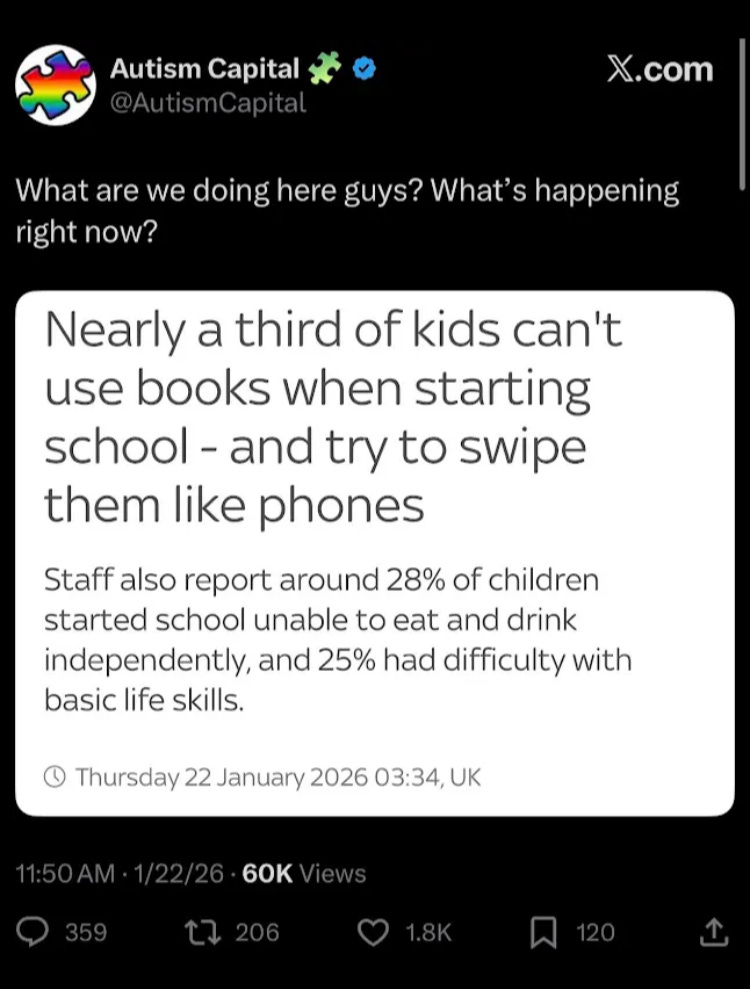
I can tell you what’s happening: a confluence of educational investors and consultants, lazy teachers, and emotionally maternal educators who want to keep kids “engaged” have formed a silent cartel and quickly pushed textbooks, homework, writing (actual writing), and critical thinking out of the classroom. In my school, we’re not supposed to issue textbooks or assign homework. Naturally, I did both.

I won’t keep you in suspense. It’s not necessary for my purposes with this essay (probably some of you won’t read until the end anyway - I develop all of this at length in Part 2). My students’ test scores were outstanding. In a school in which 35-55% of students generally tested at or above grade level in the major subjects, 82% of my students (the ones not in the early stages of ESL or without profound learning disabilities, those students never factoring in to such school-wide metrics) tested at or above grade level. More than 1/3rd achieved a ‘5’ (the highest score) on their “End of Course” (EOC) exam, the target that we’re all aiming for throughout the year. And I don’t think I’m being overly generous to myself when I say that the material isn’t easy. It’s actually surprisingly difficult.
Some example questions:
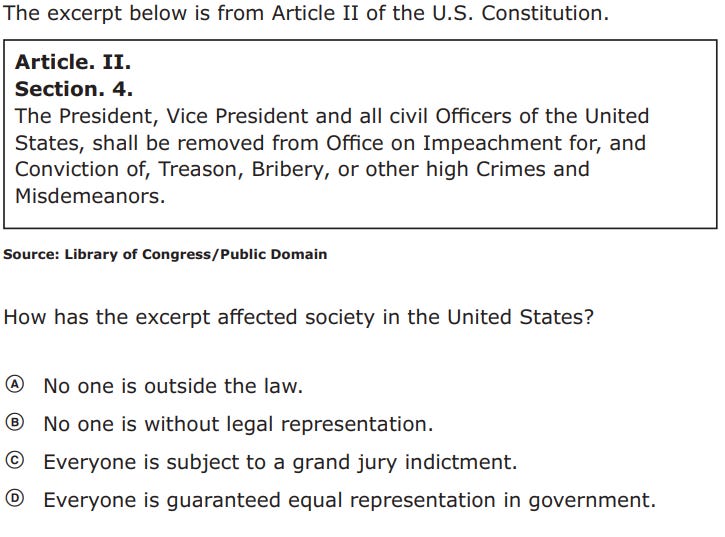
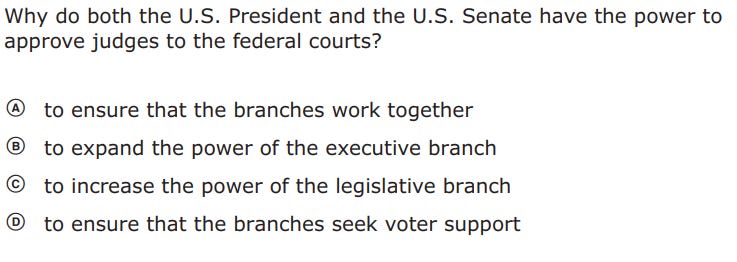

A lot of this isn’t even Civics! You need to understand the history of the 20th century, international relations, jurisprudence, etc. to answer these questions correctly. But we reviewed ALL of these subjects. A school year is a long time, and even dullish students can absorb a tremendous amount if they’re pushed.
I want you to try to read the questions above not with your eyes, but with the eyes of a 13-year old Haitian student who has never taken a real history class, knows almost nothing about geography (95% of the students in one of my classes didn’t know that “Canada” was “the country North of the United States”) and don’t know what “society” or “civil” or “impeachment” or “economic” or “federal” means.
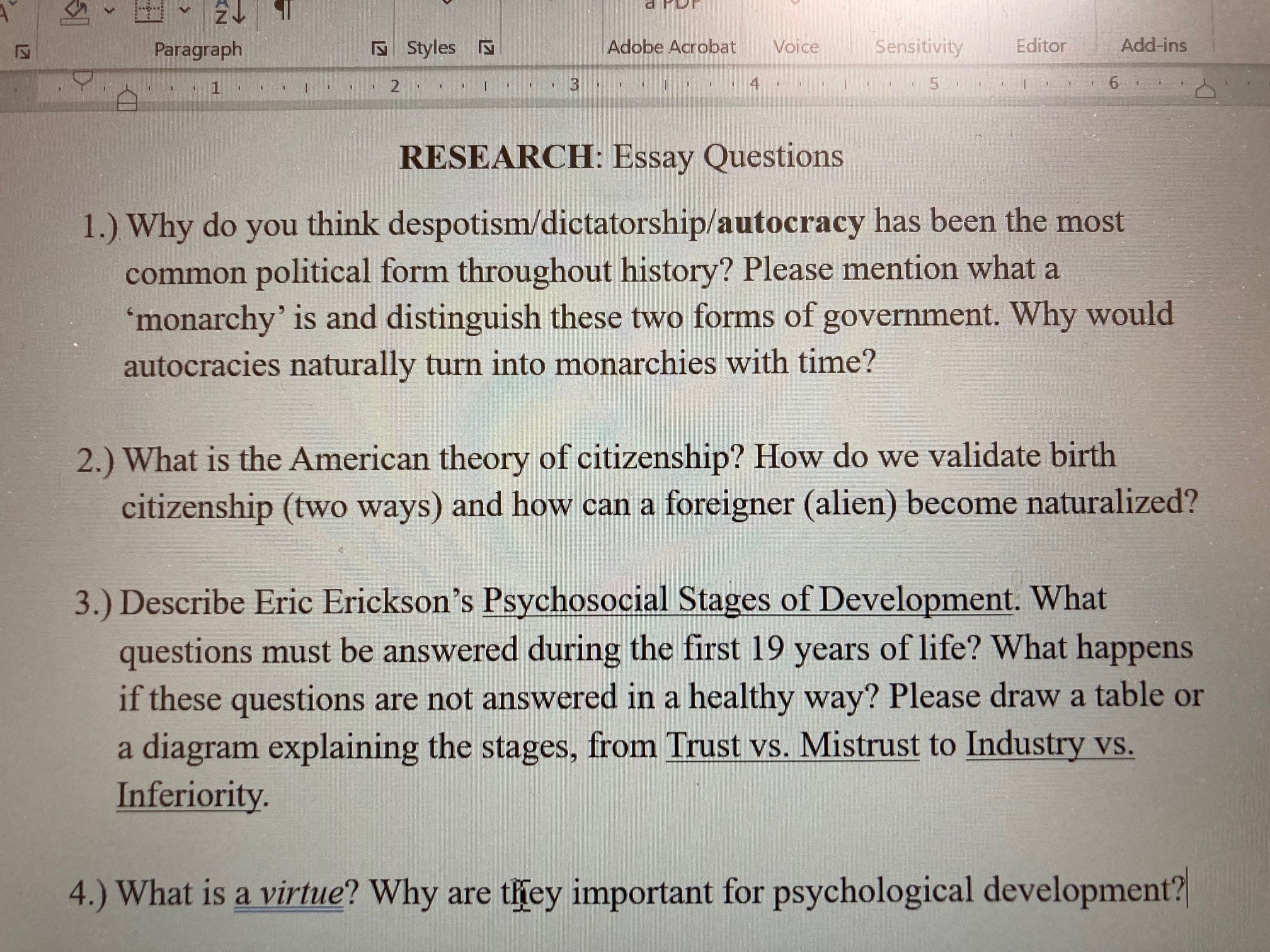
The class assignment above is not unusual. Much to their chagrin, my students had to answer these kinds of questions in written form several times per week. And I graded everything.
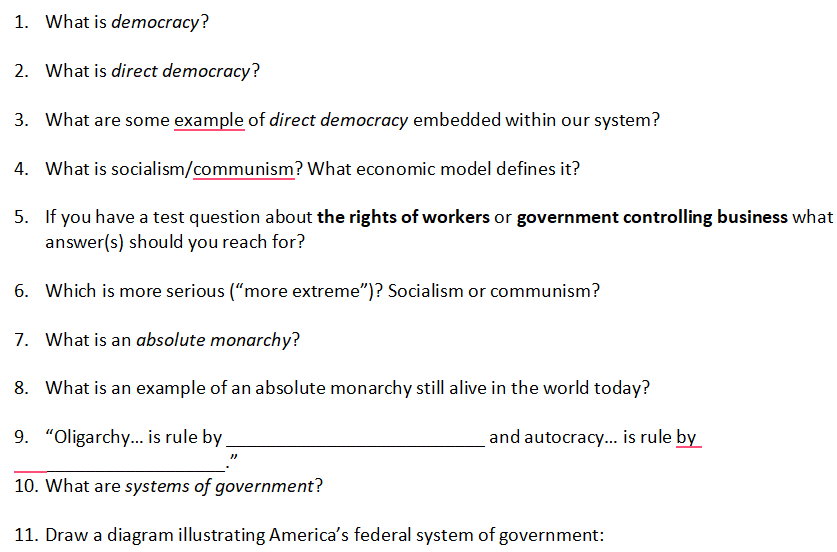
The work that I assigned became legendary for volume and difficulty (legendary in the context of my school, anyway). I was giving my students a quiz like this every 3 days or so, with essays and note-taking assignments and video links stacked on top of it all.
So my students hit it out of the park. I couldn’t have been more proud, and not just of them. I realized, at one point, that I was more proud of their learning than I had been of anything I’ve ever done in my life. They took a practice EOC in April and afterwards I told them that it was “crunch time” and I assigned them flashcards and gave them credit for cards created. We would go outside to the athletic fields and they would sit on the picnic tables across from one another and quiz their counterpart and be quizzed in turn. They’d never used flashcards before, and many took a liking to the focused, rhythmic, social, competitive character of the task, and they began to quiz each other with flashcards in the cafeteria before school and during aftercare and while waiting for their rides home (charter schools don’t have buses). Teachers were coming up to me and administrators were noticing and I realized, I did this. It was a profound feeling. Obviously they had made the cards and they were using them… but I’d initiated the process. And that’s when I really understood the power of teaching. I still don’t buy all of the ‘support’ language or the constant energies to make school a (emotionally) safe environment, and I scoff when I’m told that cheaters shouldn’t receive a zero, or that students need to “buy in” to a set of classroom rules for their to be success (nonsense; you punish rule-breakers with increasing severity, until you reach a point of intransigence, at which point they should be removed from class and from school altogether) but I must admit: educating students has changed me. I take the same delight in pushing my less impressive students a little farther as I do in watching very bright students excel (odd, for a cognitive elitist). And the constant challenges and disruptions and equivocations became a kind of amusing background noise to me. I felt deeply invested in my students in a way that I can’t describe. I think they could sense that also, which is why their behavior improved with time (although it was rarely great). They’re kids, after all - half-formed little lumps, trying to become functional adults. God knows it’s a struggle, and it’s a destination that many legal adults haven’t reached (more than ever before, it seems).
And if we make these students conform to rigid rules and give them difficult and required learning tasks they might just get there.
Thanks for reading. Take care of yourself.

In Part 2 I will describe the social life of my school and the bonds that formed between students and myself - the Veteran’s day event, climbing a palm tree, my birthday, and all the rest. I will also continue my analysis of modern education and its cultural trends from my particular vantage point.
Below I’ve included some similar essays, about my nascent teaching career:

Two Weeks In

A collection of my notes concerning my first two weeks of teaching (middle school Civics and a Research class) at a mostly-nonwhite and poor/working-class school and the life currents which brought me here.
Subscribe to read Part 2, and to receive future essays about feminization, equity, and bureaucratic malincentives in modern primary education. Your support means a lot - there’s a non-zero risk of me suffering negative consequences due to what I write but I think it’s important, just as I believed that it was important to impose discipline and push my students towards difficult academic achievement.


" (and none of them even knows that J.D. Vance is president)"
Do you know something that I don't know?
"no academic training in education"
That might be an actual benefit to you. You don't have to un-learn misguided ed-school notions.
"So my students hit it out of the park"
Those are fantastic results. It's funny how invested one gets in the students' success.
Some of those test questions are tougher than I would have expected for sixth grade.
Overall a very enjoyable read.
You’re doing the Lord’s work. I won’t know where to begin and I would likely jump off a bridge. I’m occasionally tasked with working with 20-30 year old co workers, and most of the time is spent trying to get them to do anything at all. They got the job because they showed up for the interview. Working with them is like working alone, only harder.
My own children took to honors in school without much difficulty, obviously because there was just not much competition. You can change the world in junior high, but I don’t think it can be fixed in college. Keep it up!
By the way, this is the most interesting subject matter I’ve seen in some time on Substack, or anywhere for that matter.